Showing posts with label Bethmann-Hollweg. Show all posts

Wednesday, August 26, 2015

August 26th, 1915

- Chancellor Bethmann-Hollweg convenes a conference at Pless today to discuss the diplomatic crisis that has ensued from the sinking of the passenger liner Arabic on the 19th.  He argues that there is no point arguing over whether the Americans ought to be outraged or not; the fact is they are, and that war is possible if decisive action is not taken.  His position that the Americans must be appeased by restricting submarine warfare is supported by Falkenhayn, who hopes that the United States can be kept out of the war.  Only the naval officers present insist that unrestricted submarine warfare must be allowed to continue, and that any concessions to the Americans would constitute pandering.  The navy is overruled, and Wilhelm II authorized Bethmann-Hollweg to conclude a diplomatic agreement with the Americans that defers to the latter's wishes regarding submarine warfare.  Admiral Bachmann, chief of the naval staff, asks to be relieved rather than execute a policy he disagrees with, and he is replaced by Admiral Hennig von Holtzendorff, a personal friend of the Chancellor and a skeptic of the ability of unrestricted submarine warfare to bring Britain to its knees.

- On the Eastern Front the German 12th Army finally manages to capture the Russian fortress of Osowiec today, which had repulsed prior assaults.  For several weeks it had served as a northern 'hinge' for the Russian retreat from Poland.  With the Russian armies to the south having pulled back behind the line of the fortress, Osowiec has served its purpose, and the Russians have withdrawn eastwards.

To the south, the fortress of Brest-Litovsk is also seized today; in the predawn hours advance elements of the German 11th Army pierce the inner fortifications and reach the Bug River, where they find the highway bridge in flames, set alight by the retreating Russians.  Despite their best efforts, however, vast quantities of food and supplies fall into German hands with the capture of Brest-Litovsk, including once again a significant stockpile of artillery shells that could have been put to much better use by the armies in the field.  The Russian forces on both flanks of the fortress also retreat, and 11th Army and the Army of the Bug make significant progress today, with the Guard, X Reserve, and XXII Reserve Corps reaching the line Rudka-Pruska northeast of Brest-Litovsk this evening.

German soldiers outside the burning citadel at Brest-Litovsk.

The Eastern Front after the fall of Brest-Litovsk, Aug. 26th, 1915.

- The second phase of Conrad's offensive opens today with the advance of the Austro-Hungarian 1st Army southeast from the line Kowel-Vladimir-Volynski.  Though the pace of the advance is slowed by the vast swamps of the region, which require foot-bridges to cross, the Austro-Hungarians are able to make encouraging progress against light opposition from Russian cavalry.  General Ivanov of Southwest Front, however, had not been ignorant of the potential threat to his northern flank with the withdrawal of 13th Army to the northeast, and had instructed General Brusilov of 8th Army to stretch his northern wing back from the Bug River to cover Lutsk, and the latter had deployed four cavalry divisions to screen his exposed flank.  The Russians have also used the two months of relative quiet along this stretch of the front to reinforce their battered divisions, and their average combat strength has risen from four to seven thousand.  The new recruits, however, are dreadfully inexperienced, and many lack rifles.

- British and French officials confer at Duala today regarding the campaign in German Kamerun, and decide on a joint thrust to Jaunde after the end of the rainy season (October in the east and November in the west).

Thursday, July 09, 2015

July 9th, 1915

- Even though the Kaiser had given permission on May 5th for Zeppelin raids on London east of the Tower, this has been insufficient for those within the German navy who desire a more thorough and intensive bombing campaign against Britain, one which specifically targets the City of London, the financial heart of the British Empire and home to the Stock Exchange, the Bank of England, and the headquarters of numerous mercantile firms.  Desiring to have the restriction lifted, Vice-Admiral Gustav Bachmann uses the recent French bombing of Karlsruhe in approaching Bethmann-Holweg today to argue for free reign for the navy's Zeppelins.  The Chancellor agrees to permit bombing raids on the City, provided that they be undertaken only on weekends (to prevent significant civilian casualties) and that historic buildings such as St. Paul's Cathedral and the Tower be spared.  While such limits may sound good in theory, they are hopelessly impractical for Zeppelin crews struggling to identify targets in darkness and while under fire.  Bachmann is thus not satisfied with Bethmann-Hollweg's concession.

- The Russian 3rd Army attacks all along the front in southern Poland today, and the Austro-Hungarian 4th Army is able to hold its positions only by the slenderest of margins after bitter hand-to-hand fighting and several counterattacks to recover lost ground.  Reports from the Austro-Hungarian corps commanders, however, emphasize the exhaustion of the infantry, especially in light of the oppressive heat and lack of water.  Fearing that the Russians may be able to break through by tomorrow afternoon, 4th Army commander requests additional reinforcements; in response Conrad reassigns 4th Division, formerly of 1st Army and en route to the Bug River, to 4th Army.

- In March 1915 the Austro-Hungarian navy, realizing that the war would be lengthy, decided to order the construction of four submarines based on the design of the Havmanden-class, three of which had been built for Denmark before the war by the Whiteyard in Fiume.  This being Austria-Hungary, of course, internal politics naturally had their role to play: the Hungarian government demanded a significant share of production be allocated to Hungarian firms.  To achieve this, the contract signed today provides for the submarines to be partially built in Linz and Pola, after which the parts will be transferred to Pola or Fiume for completion.  Such unnecessary duplication of effort has been endemic to the Dual Monarchy both before and during the war, and is one of the key impediments to an adequate mobilization of the economy to support the war effort.

- Prime Minister Botha of South Africa accepts the surrender of the German colony of South West Africa today, the latter becoming the second of Germany's four colonies (the first being Togoland) to submit to the Entente since the outbreak of the war.  In the course of this campaign the South Africans suffered a mere 113 dead through enemy action and 153 through disease or accident; a further 263 had been wounded; indeed, the South Africans had suffered greater losses suppressing the Boer Rebellion than in the fight for German South West Africa.  Central both to the low casualty total and indeed the campaign itself has been mobility; repeatedly as the main South African column advanced inland from the coast, it used mobility to outflank German positions and force the latter to fall back.  More than half of the soldiers under Botha's command were mounted, a ratio not only in complete contrast to the fighting in Europe but largely unseen since the sixteenth century.  Coupled with the timeless use of horses and mules, however, was a modern innovation: the internal combustion engine, as the rapid advances were only sustainable because trucks carried water over deserts.

German casualties were also light; only 103 were killed and 195 wounded, while 890 were made prisoner.  The preponderance of POWs among the German total reflected the unwillingness of the defenders to fight to the bitter end.  Further, the remaining German force in the field upon surrender numbered 4730 men, and included thirty-seven field guns, eight thousand rifles, and two million rounds of ammunition.  The Germans had the manpower and material to continue resistance through a guerilla campaign, but lacked the willingness.  Of crucial import was that the white officers and soldiers were also colonists.  Not only would a guerilla campaign destroy the economy and infrastructure of the colony they had created, but the social dislocation that would have ensued would have undermined the racial hierarchy that was the very basis of the colonial project.  For many Germans in the colony, the maintenance of white rule was a greater priority than the maintenance of German rule.

Further, this concern was shared by the South Africans:  the terms of the armistice allowed Germans reservists to return to their homes, German schools to function, and the German civilian administration to remain in place.  What Botha and the South Africans aspired to was to rule German South West Africa as a colony, and in this endeavour white rule would be as crucial as it was in South Africa itself.  Thus, once military resistance had ceased, it was in the interests of South Africa to cooperate with the white German colonial population to maintain minority rule over the majority indigenous population.  Though the campaign in German South West Africa had been triggered by the outbreak of war in Europe, how the campaign was fought and the settlement which followed were of a piece with the nature of European imperialism and colonial rule in Africa.

Sunday, May 31, 2015

May 31st, 1915

- Despite the order from the Kaiser on May 10th to avoid the targeting of neutral ships, steamers from Denmark, Norway, and Sweden have been sunk by German submarines over the past few weeks.  Chancellor Bethmann-Hollweg realizes that the navy has ignored the imperial instruction, and thus convenes a meeting with the kaiser and the military chiefs today to resolve the matter.  Here the chief of staff of the navy once again asserts that it is impossible to modify unrestricted submarine warfare, and again argued for its continuation.  The Kaiser, not wanting to appear weak before his military chiefs and the German public, now states that the prior order not to target neutral ships could only be published if it was endorsed personally by the chancellor, a qualification Bethmann-Hollweg accepts.

- This evening the French XXXIII Corps attack towards Souchez, and manages to seize the trenches on the northern and sourthern flanks of the sugar factory to the west of the village.

- After the fall of Pralowce yesterday at dusk, the Russians prepared an immediate counterattack.  A heavy artillery barrage opens at 3am, and waves of Russian infantry are able to overwhelm the Austro-Hungarian defenders by mid-morning.  On the northern flank of Przemysl, however, 11th Bavarian Division is able to occupy three important defensive positions after intensive bombardment by heavy mortars forced the Russian defenders to abandon their entrenchments and fall back.

Meanwhile, to the southeast of Przemysl the Austro-Hungarian 27th Division seizes the first Russian trench line on the heights at Gaj.  However, the Russians are able to fall back to prepared reserve positions, and in light of the strength of the enemy defences the commander of the Austro-Hungarian 3rd Army postpones further attacks until June 2nd, to give time for the infantry to work their way closer to the Russian line.  Further to the southeast, Südarmee makes progress, capturing the city of Stryj and over nine thousand Russian prisoners.

The advance of Südarmee, May 31st to June 3rd, 1915.

- General Townshend's 6th Indian Division launches its attack on the Ottoman defensive positions north of Qurna at 5am this morning.  On the surface the Ottoman position is strong - seasonal floods has transformed much of the countryside into marsh, meaning the Indian infantry can only attack the enemy defences by front amphibious assaults.  However, in the event the attack is easier than Townshend expected, as the Ottoman defenders break under artillery fire from the British flotilla and surrender in large numbers.  By the end of the day, the landing force has seized their initial objectives and are advancing on the main Ottoman line around Bahran.

Sunday, May 10, 2015

May 10th, 1915

- Almost since the outbreak of the war the German government has been fighting a losing battle over its image abroad among neutrals.  While Entente propaganda has undoubtedly made its mark, views on Germany have been inevitably tainted by the way in which it has conducted the war, as more recent incidents such as the use of gas at Ypres and the sinking of Lusitania join with such older episodes as the Rape of Belgium to cast Germany as the villain.  The German government has attempted to counter such impressions since the first weeks of the war, and today publishes a White Book on the German occupation of Belgium.  Its title - The Conduct of the War by the Belgian People in Violation of International Law - says all that needs to be said regarding its aim.  Its objectivity is questionable at best and much dubious 'evidence' is included, and does little to dissuade those who already believe in German perfidy from continuing to do so.  Moreover, the Germans are not the only ones who can publish reports . . .

- Even as the German government attempts to defend its conduct of the war, the latest outrage - the sinking of the passenger liner Lusitania - is provoking a violent reaction in Britain, especially in Liverpool and other west coast ports in which many of the dead resided.  For these civilians, the torpedoing of Lusitania is seen as culmination of a German campaign of deliberate barbarism that has included the Rape of Belgium, the bombardment of Scarborough and other towns, Zeppelin bombing raids, and the use of gas at Ypres.  For many the news of Lusitania's loss is the final straw, and over the past few days anti-German riots have broken out in several British cities, including most prominently Liverpool, the destination of the doomed liner.  Large crowds rampage through commercial districts, attacking any shop identified as being owned by Germans and looting its contents.  Local police struggle to maintain order, with hundreds arrested.  Today is the worst day of violence in Liverpool, and hardly a single commercial enterprise owned by a German remains unscathed at the end of the day.  While the violence builds on existing anti-German sentiments and indeed xenophobia, they also arise from the general sense among the British public that the German methods of waging war are a fundamental threat to Western civilization, and that the war is not only worth fighting but must be fought until absolute victory can be secured and 'Prussian militarism', as it is often referred to, is crushed forever.  Whether right or not, such views are genuinely held by much of the British public, and go some way to explaining the overwhelming support for the continuation of the war in the months and years ahead.

The aftermath of the Lusitania riots.

- A more measured reaction to the sinking of Lusitania is seen today in the United States when President Woodrow Wilson delivers a speech before fifteen thousand in Philadelphia.  After several days of deliberation, he has come to the conclusion that an immediate declaration of war is not the proper course of action.  More crucially, imbued with a moral sense of American righteousness, he proclaims to the assembled crowd that:
. . . the example of America must be a special example . . . the example, not merely of peace because it will not fight, but of peace because peace is the healing and elevating influence of the world and strife is not.  There is such a thing as a man being too proud to fight.  There is such a thing as a nation being so right that it does not need to convince others by force that is is right.
Wilson's proclamation is greeted by prolonged cheering.  In Britain, perhaps not surprisingly, the president's words are not so welcome - Wilson's high-minded rhetoric appears completely divorced from the perceived reality of a struggle for civilization, and there is little inclination to take lessons in morality from someone whose country is resolutely on the sidelines.

- In Germany, reaction to the sinking of Lusitania has been mixed.  Much of the public, convinced that the liner was carrying munitions, celebrates its destruction, as does the naval leadership.  For the Chancellor and the Kaiser, the sinking is seen as a disaster.  Wilhelm II directly orders the naval chief of staff that
. . . for the immediate future, no neutral vessel shall be sunk.  This is necessary on political ground for which the chancellor is responsible.  It is better than an enemy ship be allowed to pass than that a neutral shall be destroyed.
Learning of the Kaiser's order, Bethmann-Hollweg informally conveys to Washington that German submarines have been instructed to avoid neutral vessels.  Unfortunately for the pair, the naval chief of staff is committed to unrestricted submarine warfare, and in an act of deliberate insubordination does not convey the Kaiser's order to the fleet.  For now the ostensible leaders of Germany are kept in the dark.

- In Artois today the French 10th Army attacks all along the German line, attempting to repeat the fleeting success of yesterday.  Overall the French attacks fail: an attempt to move further east on the Lorette spur was held, and repeated attacks by 70th Division at Carency were also repulsed.  However, a German counterattack by elements of 58th and 11th Divisions also fails, and the French XXXIII Corps is able to maintain control of the ground seized yesterday.  This salient also leaves German positions at Carency and Ablain just to the north almost isolated, and the commander of the German 28th Division, responsible for this section of line, is concerned that the villages may have to be abandoned.

Further north, in light of the complete failure of the attacks of yesterday, Sir John French calls off the British offensive towards Aubers Ridge early this morning.  General Haig, whose 1st Army had been responsible for the operation, is dismayed at the failure.  Writing in his diary, he concludes that the defeat 'showed that we are confronted by a carefully prepared position, which is held by a most determined enemy, with numerous machine guns.'  To overcome such defences, Haig believes that an 'accurate and so fairly long' preliminary bombardment will be necessary in future to ensure enemy strong points are destroyed before the infantry advance.  However understandable Haig's conclusions may be, he is learning the wrong lessons.

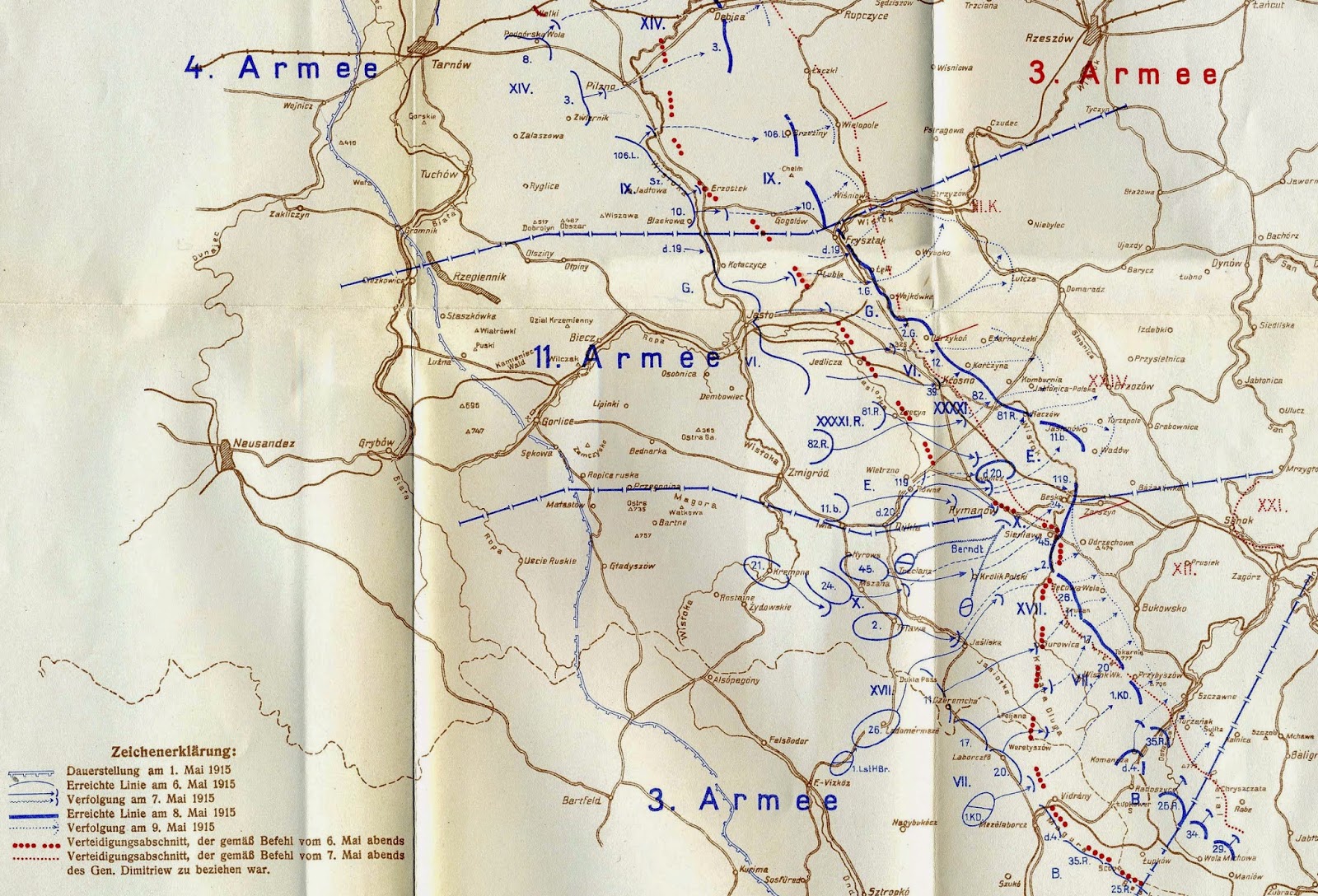
- Overnight the Russian counterattack in Galicia is launched, with 44th Division advancing towards Jacmierz into the gap between 11th Bavarian and 119th Divisions and 33rd Division to the south advancing towards Besko.  Though the Russians are able to initially gain some ground, the German commanders are more than equal to the task.  To the north, 11th Bavarian Division pushes back the southern flank of XXIV Russian Corps to the north, which creates space for the German 20th Division to come up from its reserve position and launch a attack co-ordinated with 119th Division on the Russian 44th Division, throwing the latter back.  To the south, the Austro-Hungarian X Corps secures the high ground near Odrzechowa, threatening the flank of the Russian 33rd Division.  By nightfall the Russians have been repulsed and are retreating eastward towards Sanok.

The counterattack by the Russian XXI Corps had been the last throw of the dice for 3rd Army, and its defeat means any hope of holding the Germans west of the San River has evaporated.  General Ivanov's chief of staff sends a despondent message to Stavka this evening, stating that the army is shattered and the situation is hopeless, and the only option is a pell-mell retreat eastwards: Przemysl will have to be surrendered, the Germans will soon invade the Ukraine, and Kiev should be fortified.  The chief of staff is promptly fired, but Stavka finally acknowledges reality and finally acquiesces today to General Dimitriev's repeated requests to retreat behind the San, 3rd Army is a mere shell of its former self.  Of the 200 000 men it had on May 2nd, only 40 000 remain to retreat eastwards today, and this despite 3rd Army having received 50 000 replacements in the meantime.  Further, the Germans have taken 140 000 prisoners, reflecting the shattered morale of the Russian infantry.  Some of its formations have simply ceased to exist: IX Corps has suffered 80% casualties, while III Caucasus Corps, which was sent into the battle on May 4th to restore the situation, has instead lost 75% of its strength in the six days since.

The strategic implications of the crushing defeat suffered by 3rd Army also continue to spread.  In order to maintain some semblance of coherent line on the Eastern Front, Stavka issues orders for the southern flank of 4th Army to pull back east almost to the confluence of the San and Vistula Rivers, while 8th Army in the Carpathians will have to retreat to the northeast and reorientate to face to the west instead of the south.

The German offensive at Gorlice-Tarnow, May 10th to 12th, 1915.

- Though the Treaty of London had been signed on April 26th, details remained to be finalized regarding the nature of Italian co-operation with the Entente, and at sea Italy is in particular eager to secure substantial naval support in the Adriatic.  Today in Paris a naval convention is signed between Britain, France, and Italy which calls for the creation of an allied fleet in the Adriatic under Italian command, to which the French would contribute twelve destroyers, a seaplane carrier, and a number of torpedo-boats and submarines, while the British pledged to dispatch four pre-dreadnoughts and four light cruisers.  The British reinforcements in particular, however, are to be drawn from the fleet off the Dardanelles, and will not be sent to the Adriatic until they have been replaced by similar warships from France.  This detail will be the source of friction between the allies once Italy formally enters the war.

- For Italian Prime Minister Salandra and Foreign Minister Sonnino, the driving force behind Italian intervention on the side of the Entente, the struggle now is to carry the rest of the Italian government with them into the war.  This is no easy task, as many politicians do not share their passionate desire for intervention.  Instead, a vague desire for neutrality is the most common sentiment, a position to which some within the Cabinet itself adhere to.  Moreover, King Victor Emmanuel is unreliable; just yesterday he proclaimed to Salandra his uncertainty as to the right course of action for Italy and the possiblity of abdicating in favour of his uncle the Duke of Aosta.  There is also the necessity of securing a majority in parliament for war, which is far from assured.  Finally and perhaps of most concern to the Prime Minister and Foreign Minister, there is an alternative political leader known to oppose intervention: Giovanni Giolitti, who has served as prime minister on no fewer than four occasions from 1892 to 1914.  The possibility exists that if Salandra and Sonnino cannot carry either the cabinet or parliament in support of intervention, Giolitti may form a government pledged, at minimum, to strict neutrality, if not a pro-German attitude.  Indeed, when German Ambassador Bülow browbeats the Austro-Hungarian ambassador today to agree to further concessions, he communicates the offer not to the goverment but to Giolitti; the Germans see Giolitti as the last chance to keep Italy out of the war.

For all of the difficulties that Salandra and Sonnino face, the forces opposed to intervention are not without their own problems.  Giolitti is 73 years old, and both his grip on and influence in Italian politics is not what it once was.  He also has little desire to form a government led by himself, fearing he would be branded as a lackey of Austria, and crucially communicates this belief to Victor Emmanuel in an interview this afternoon, which does much to calm the nerves of the king.  Salandra and Giolitti also meet this afternoon, and the former sufficiently dissembles to leave the latter with the impression that he is not wholeheartedly committed to war.  Still, it is possible that Giolitti may still instruct his supporters in parliament to vote against the war when it reconvenes on May 20th.  The next ten days will thus determine not only whether Italy enters the war, but indeed the future course of Italian politics overall.

- Today Admiral de Robeck cables the Admiralty a proposal for a renewed naval attack on the Dardanelles.  The suggestion originated in a meeting with Commodore Keyes, who remains a strong advocate of naval action, and is convinced that futher naval pressure can yet secure victory.  Robeck is more doubtful, and his message reflects his continued pessimism.  Even if a naval attack succeeds, 'the temper of the Turkish army in the peninsula indicates that the forcing of the Dardanelles and subsequent appearance of the fleet off Constantinople would not of itself prove decisive.  These are hardly fighting words, but Keyes hopes that even a tepid proposal will inspire Churchill to order another attempt.

- Near the mouth of the Bosporus the Russian Black Sea Fleet makes another appearance to bombard the forts, and this time the recently-repaired ex-German battlecruiser Goeben makes a brief appearance.  The Germans are dismayed to discover that the 12-inch guns of the outdated Russian pre-dreadnoughts can still fire farther than the 11-inch guns of Goeben.  After the battlecruiser takes two glancing blows it uses its superior speed to break off the battle and return to the Sea of Marmara.

Wednesday, May 06, 2015

May 6th, 1915

- As the campaign of unrestricted submarine warfare continues, Chancellor Bethmann-Hollweg remains concerned at its impact on neutral opinion.  Recalling the torpedoing of the liner Falaba in March and the tanker Gulflight in April, he writes to the Chief of the Naval Staff today, demanding the safety of neutral merchant shipping.  Otherwise, 'the growing number of neutral ships falling victim to submarine warfare [may] drive the neutral powers into the camp of our enemies.'  He has no idea just how prescient he is: out in the Atlantic, the passenger liner Lusitania is approaching the Irish coast and destiny.

- In west Galicia, detachments from the Austro-Hungarian 8th Division, as well as several Landsturm brigades, occupy the badly-damaged city of Tarnow, already evacuated by the retreating Russian IX Corps.  Other elements of the Austro-Hungarian 4th Army reach the west bank of the Wisloka River this evening, but due to exhaustion a crossing is postponed until tomorrow.

To the south, the main advance of the German 11th Army continues apace; Guard Corps captures Jaslo, while XLI Reserve Corps, advancing towards Rymanow, reaches the town of Zrecyn.  X Corps, meanwhile, reorientates itself to face south at Dukla, attempting to capture those Russian forces still south of the pass.  Of the latter, XII Corps, after hard fighting with the Austro-Hungarian 3rd Army, is able to withdraw to the northeast.  The two divisions of the Russian XXIV Corps, however, endure a greater trial: 49th Division is badly decimated before it can reach safety south of Kosno, and 48th Division, commanded by General Lavr Kornilov, is repulsed by 11th Bavarian Division and falls back to Mszana, where it is attacked by the Austro-Hungarian 4th Landwehr Division, and begins to break up.  General Dimitriev, meanwhile, informs General Ivanov that a further retreat of his 3rd Army will almost certainly be necessary.

The German offensive at Gorlice-Tarnow, May 6th to 9th, 1915.

- Off Cephalonia on the Greek west coast the Austro-Hungarian light cruiser Novara, commanded by Captian Miklós Horthy is intercepted by French warships, but is able to use its superior speed to escape back into the Adriatic.  Novara had been towing the German submarine UB8 for deployment in the Aegean, and had cast off the submarine unseen by the French.  Now on its own, UB8 makes its way eastward.

- As soon as the first Entente push to Krithia had failed on April 28th, General Hamilton began planning for another attack, as without occupying Krithia and the high ground to the immediate north the Ottomans would remain in firm control of both Gallipoli and the Dardanelles.  Additional reinforcements have now arrived, with 125th Brigade of 42nd Division, having just landed yesterday, taking up position along the west coast.  In addition, 2nd Australian and the New Zealand Brigades, on loan from ANZAC, were deployed between 87th and 88th Brigades and the French to the east.

Despite the reinforcements, however, the attack is no more successful than the first attempt.  Again and again Entente infantry find their advance held up by well-concealed machine gun nests and the rugged terrain, and at no point are they able to advance more than four hundred metres or gain anything of significance.  Notwithstanding today's failure, Hamilton orders a resumption of the attack tomorrow morning.

- Just before noon today Emden's landing party arrives at El Ula, after a four days' journey from the coast.  After the bitter fight in the desert the caravan entrenched each night, but did not encounter any resistance.  On arrival in the village they are met with a warm reception, as they had been expected by the local Ottoman garrison.  In addition to delicacies of all kind from peaches to Rhenish wine, most importantly of all they find a steam train specially chartered to take them north.  After an abundant meal and the first bath in months, the men of the landing party board the train and begin the rail journey northwards at thirty kilometres an hour.

Emden's landing party arriving at El Ula, May 6th, 1915.

Friday, April 24, 2015

April 24th, 1915

- After a short artillery bombardment, the Germans at Ypres launch a second gas attack, releasing the deadly clouds to drift over the British and Canadian lines at and north of St. Julien.  From 5am the Germans launch a series of heavy assaults on the battered 3rd Canadian Brigade.  Gassed for the second time, it has reached the limits of its endurance, and under overwhelming pressure fall back.  After midday they withdraw 700 yards south of St. Julien, yielding the village to the enemy.  To the east 2nd Canadian Brigade, commanded by General Arthur Currie, has to pull back its left wing, much as 3rd Canadian Brigade had done two days earlier.

The line at Ypres at midnight, April 24th, 1915, showing the ground yielded by 3rd Canadian Brigade today.

Still, though the Canadian line bends and ground is yielded to the enemy, it does not shatter.  Even though it is only two days since the first gas attack, already countermeasures are being improvised.  Soldiers quickly learn that chlorine gas, heavier than hair, clings to the earth, and that remaining in low ground is fatal.  Similarly, running from the gas, by making one breath more heavily, simply makes one more susceptible to its effects.  Finally, cloths soaked in urine negate much of the effect of the gas.  Though the chlorine gas still causes casualties, it is not the completely unknown terror it was on the 22nd.  Never again will a gas attack have the same psychological impact.  At Gravenstafel in particular, the Canadian 8th Battalion makes a valiant stand and, though heavily outnumbered, fights the Germans to a standstill, preventing a breakthough that could have swept behind the British 28th Division east of Ypres and unhinged the entire defence of the salient.  Again, though the Germans have gained additional ground, they have not won a decisive success, and further Entente reinforcements are en route.

French soldiers using improvised gas masks in the 2nd Battle of Ypres.

- In the St.-Mihiel salient the German counterattack shifts focus slightly to advance southwest of Les Éparges, and achieves a notable success: the capture of four kilometres of the French first trench line, two kilometres of the French second trench line, and even a battery of 75-mm artillery pieces.  General Dubail of the Provisional Group of the East reports to Joffre that the German success was due to the profligate use of artillery and trench mortars.

- At a meeting of the German and Austro-Hungarian leadership at Conrad's headquarters today, Chancellor Bethmann-Hollweg warns Foreign Minister Count Burián that the Austro-Hungarians can not count on any German military aid to fight Italy should the latter enter the war, and that such a circumstance could lead to defeat.  The one hope those assembled cling to is that impending German offensive near Gorlice and Tarnow, if successful, will perhaps convince the Italians to hold back.

The ongoing arrival of elements of the German 11th Army east of Krakow, April 24th, 1915.

- Today the harbour at Mudros on Lemnos in the eastern Mediterranean is barely-controlled chaos as final preparations are completed for the landings on Gallipoli.  One by one the transports leave the anchorage, bound for a rendezvous either at the island of Imbros or Tenedos.  The two destinations are a reflection of the plan adopted by General Sir Ian Hamilton, which calls for two main landings to be undertaken tomorrow.  The first, assigned to the ANZACs assembling at Imbros, is to land on the western side of the peninsula north of Gaba Tepe, where resistance is expected to be light.  After securing the beaches the ANZACs are to advance eastward to control part of the Sari Bair range before seizing the hill at Mal Tepe and taking Kilid Bahr, the high point on Gallipoli, on the second day.  Meanwhile, the British 29th Division and the Plymouth battalion of the Royal Naval Division, assembling at Tenedos, will be landing at a number of beaches around the Helles tip of the peninsula.  Though these positions were known to be well-defended by the Ottomans, it is hoped that naval gunfire will be able to overcome resistance.  By the end of the first day these forces are to have seized the heights at Achi Baba behind the village of Krithia, and on the second will join the ANZACs in capturing Kilid Bahr.  Once the high ground along the centre of the peninsula is seized, the Dardanelles coast can be clearing of enemy artillery and the minesweepers can finally complete their work.  At the same time as the main landings, diversionary attacks will be made by the French at Kum Kale on the Asiatic shore and elsewhere to confuse and distract the Ottomans.  It is a complex operation, and Hamilton hopes that by conducting so many landings simultanously the Ottomans will be unable to concentrate overwhelming force against any of them.  In practice, what Hamilton has done is divided his own force such that none will be able to achieve its objectives.

- Cevdet Bey reports to Constantinople today that the Armenian rebels in the city of Van number four thousand, have barricaded themselves in the Armenian quarter, and are proving impossible to dislodge.  As artillery is brought in to bombard Van, the Ottomans allow fifteen thousand Armenian civilians escaping massacres in the countryside to join the besieged rebels.  This is not done out of any sense of mercy, of course; rather, the hope is that the more mouths there are to feed in Van, the quicker they will all starve to death.

With the rebellion continuing in Van, the Young Turk leadership moves to implement further measures against the Armenian population.  Talat Pasha, the Minister of the Interior, issues orders for the arrest of all prominent Armenians in Constantinople, while Enver Pasha, the Minister of War, sends orders to army commanders in eastern Anatolia to deport the Armenian population in those regions where they are in open revolt.  The key dispatch, however, is a second message written by Talat Pasha, sent to the commander of 4th Army in the Caucasus.  The Minister of Interior states that deporting Armenians to the Konya region, as has been done in the past, is no longer feasible, since concentrating substantial numbers of Armenians in such a location would simply create further problems.  Instead, those Armenians 'whose expulsion from places like Iskenderun, Dörtyol, Adana, Haçin, Zeytûm, and Sis has been deemed necessary, to the southeast of Haleb, Zor, and Urfa'.  The vilyats named by Talat are to be found in the Syrian interior; in other words, Talat is ordering the Armenian population in the region of Van to be relocated into the desert and left to their own devices.

Friday, April 10, 2015

April 10th, 1915

- General Dubail reports to Joffre today that, in line with the Commander-in-Chief's instructions of the 8th, he intends to make four concentrated attacks on the St.-Mihiel salient in the coming days.  Two will be aimed at the western face of the salient: one on a four-kilometre front near Maizeray, and the other on the heights immediately south of Les Éparges.  Two further assaults will be directed towards the southern face of the salient, both near its centre.

- In March, Austria-Hungary agreed to surrender the province of Trentino to Italy after the war, if Italy were to remain neutral.  However, given the ongoing Austro-Hungarian defeats, highlighted by the surrender of Przemysl, such a concession is no longer sufficient for the Italian government.  Believing the Dual Monarchy to be gravely weakened and in no position to negotiate, the Italians raise their demands today, requesting the entirety of South Tirol, the Adriatic coast from the present border to Trieste, with the latter declared a free city, several Dalmatian islands, and a declaration from Austria-Hungary that Italy would henceforth have a free hand in Albania.  Given how long it took the Austro-Hungarian government to come around to the idea of handing over Trentino, it is hardly to be expected that they would submit to such escalated demands.

- Given the growing diplomatic crisis with Italy, coupled with Conrad's continued unwillingness to countenance territorial concessions, Falkenhayn sends a telegram to Chancellor Bethmann-Hollweg, warning him of the attitude of the Austro-Hungarian chief of staff and makes the following request:
Exert utmost pressure in Vienna in order to effect acceptance of Italian demands even if excessive.  At the same time, announce Germany's willingness to give greater military assistance in the East and if necessary to cede Prussian territory.
- In the central Carpathians the German Beskid Corps is now wholly in the front line, having relieved four Austro-Hungarian divisions, giving Conrad a substantial reserve for the first time in several weeks.  The counterattack of the German divisions over the past week have disrupted the Russian offensive in the Carpathians and inflicted forty thousand casualties on the enemy.  As a result, General Ivanov of South-West Front orders a halt to the attacks of 3rd and 8th Armies today, stating that the arrival of German reinforcements have tipped the balance.  Instead, he intends to wait for the arrival of III Caucasian Corps before resuming the attack.

- In northern German Kamerun, a German attack along the Benue River forces the Emir of Yola in northern Nigeria to flee his capital and threatens British influence in the region.  Frederick Lugard, the colonial governor in Nigeria, calls for the capture of the town of Garua in German Kamerun as a means of restoring British prestige.

Sunday, February 01, 2015

February 1st, 1915

- Admiral Hugo von Pohl, Chief of the German Naval Staff, had interpreted the British declaration of November 1914 that the entire North Sea was a war zone as an effort to deter neutrals from sailing to Germany, and in particular to starve Germany via the interruption of food imports.  In response, Pohl had become a convert to the idea that Germany should use its own submarine force to attack merchant shipping bound for Britain.  Today in a meeting with Chancellor Bethmann-Hollweg, he advocates a shift in strategy to embrace what is known as unrestricted submarine warfare.

According to international maritime law, a specific procedure was to be following when a warship intercepts merchant shipping.  First, the attacker would have to halt the merchant ship either by signals or a warning shot.  Second, sailors from the warship would have to board the merchant ship to ascertain its cargo and nationality.  Third, if the merchant ship belonged to the enemy, provision had to be made for the safe evacuation of the crew and any passengers.  Only at this point could the warship actually sink the merchant ship.  These rules were drafted in the age of the sailing ship, when the attacker would be a fast light warship that nevertheless would have space to take the merchant crew aboard.  On the other hand, these rules were manifestly impossible for submarines to follow if they were to achieve any success.  Submarines relied on stealth and surprise, advantages which would have to be surrendered if they had to signal a merchant ship to stop first.  Second, a submarine is at its most vulnerable when on the surface, making it potentially disastrous to stop and wait while sailors board the merchant ship to inspect it.  Finally, the size of the submarine left no room whatsoever to take on the crew of a sunk merchant ship.  To operate in line with contemporary maritime law would greatly reduce the value of a submarine as a weapon against enemy shipping, and hence was referred to as restricted submarine warfare.

At the outset of the war the general expectation on all sides was that submarines would still adhere to maritime law, and indeed German submarines had done so for the first six months of the conflict.  However, given the tightening British naval blockade, Pohl is not the only German admiral to advocate that the U-Boat force stop adhering to international law in order to reach their full potency as a weapon against British trade, which is referred to as unrestricted submarine warfare.  To its advocates, this policy promised a means to strike back at the one main enemy that remained frustratingly beyond the reach of the German army or the High Seas Fleet.  Moreover, given British reliance on imports, especially of food, unrestricted submarine warfare had the potential to cripple the British economy, and perhaps even force its surrender.

Unrestricted submarine warfare was not without its difficulties.  For one, it would be another action that would tarnish the image of Germany elsewhere, and of particular concern was the potential for neutral merchant ships to be sunk by accident, which might lead to additional countries entering the war on the side of the Entente.  The biggest neutral, of course, is the United States, and the fear expressed by some is that adopting unrestricted submarine warfare may push it closer to the British.  Further, there could easily be incidents where passenger liners are mistaken for merchant ships, and the sinking of the former could lead to substantial civilian casualties and international outrage.  These reasons are why not only the German Chancellor but the Kaiser himself have refused to date to endorse the implementation of unrestricted submarine warfare.

Pohl, however, has persisted in his advocacy, and today attempts to assuage the Chancellor's concerns.  He argues that if Germany declares a war zone around Britain, it will scare away neutral shipping, which means that there will be neutral merchants in the area for U-Boats to sink by accident.  In additional, Pohl declares that submarine captains are able to distinguish between enemy and neutral ships, and between passenger liners and merchant ships.  Given these assurances, Bethmann-Hollweg consents to unrestricted submarine warfare.

Tuesday, January 20, 2015

January 20th, 1915

- As the Zeppelins L 3 and L 4 return to their airbase of Fuhlsbüttel at 940am and 947am, the news of the first bombs dropped on Britain by airships is published in the German press to widespread acclaim.  The reaction in government circles is somewhat more guarded; Wilhelm II praises the conduct of the raid, but is disturbed by the apparent bombing of the royal palace at Sandringham, raising fears among the military leadership that the temperamental Kaiser may yet rescind permission to bomb Britain.  Chancellor Bethmann-Hollweg, meanwhile, is concerned at the impact on opinion in the neutral states, especially in the United States, over the apparent bombing of undefended cities for no great military gain.  In Britain, meanwhile, satisfaction with the negligible damage is mixed with concern at the inability to prevent such raids - while anti-aircraft guns have been deployed around London and a small number of military targets, the two German Zeppelins had attacked elsewhere and thus flew with relative impunity.

- On the Eastern Front General Ivanov of South-West Front believes the decision by Grand Duke Nicholas to focus on an invasion of East Prussia, as prompted by General Ruszkii, fails to take account of the apparent Russian superiority in Galicia.  Instead, as he informs his subordinates today, Ivanov intends to push into and through the Carpathian Mountains into the Hungary plain, possibly knocking Austria-Hungary out of the war entirely.  Regardless of the merit in Ivanov's plan, it means that once again North-West and South-West Front are working at cross-purposes, pursuing their own plans instead of coordinating their efforts.

- Over the past two days the Mecklenburg 14th Jäger Battalion and the 11th and 15th Ulan Regiments have attacked in the Vosges, working their way around the southern flank of Hartmannswillerkopf, isolating the French defenders on the summit.  In preparation for a final assault on the mountain, it is targeted by a heavy artillery bombardment.

Friday, January 02, 2015

January 2nd, 1915

- Early this morning a dispatch from the British attache at Russian army headquarters arrives at the Foreign Office, conveying Grand Duke Nicholas' request that the British undertake a diversionary operation to distract the Ottomans from the Caucasus.  Foreign Secretary Grey conveys the message to Lord Kitchener, who then discusses the possibilities with Churchill.  Kitchener is eager to assist the Russians to avoid their collapse and surrender, but is adamant that no forces can be spared from the Western Front.  Instead, Kitchener inquires whether the navy could make a demonstration against the Dardanelles, and the suggestion piques Churchill's interest.

- In Champagne five French regiments attack the centre of the German VIII Corps at 6pm, but fail to secure any ground.

- Chancellor Bethmann-Hollweg has learned of Falkenhayn's intention to deploy the newly-raised four and a half reserve corps on the Western Front in order to undertake a major offensive.  The Chancellor, however, shares the views of Hindenburg and Ludendorff that these new formations should instead be assigned to the Eastern Front to secure a decisive victory that among other objects will influence neutrals like Italy and Romania.  Having already lost confidence in Falkenhayn as a result of the failure at Ypres, Bethmann-Hollweg recommends, in a meeting with the Kaiser, the removal of Falkenhayn and his replacement as Chief of Staff by Ludendorff.  Wilhelm II may be one of the few who still has confidence in Falkenhayn, but while he has no real influence over the operations of the German army, his is still the decisive voice regarding who will command it.  The Kaiser thus refuses the Chancellor's suggestion, and Falkenhayn remains Chief of Staff.

- The Ottoman offensive against Sarikamish has now completely fallen apart.  IX Corps is down to only a thousand men, and is under attack from the rear by Russian units at Bardiz.  Enver Pasha, who had been with IX Corps, slips away to join XI Corps, still fighting the main Russian force southwest of Sarikamish.  Meanwhile, the remnants of X Corps begin to pull back from north of Sarikamish before dawn this morning.

- In German Kamerun a British force advancing north from Duala occupies Dschang today, and destroy the fort located there.  From the British perspective, they have secured their immediate objectives in German Kamerun - they have seized the key port of Duala and cleared its hinterland of German forces that might have been able to undertake an effort to retake the town.

From the perspective of Colonel Karl Zimmerman, German commander in Kamerun, however, the situation is still manageable.  Though the west around Duala and the southeast have been lost to the British and French respectively, neither development is either a surprise - Duala could hardly have been held in the face of British naval power - nor decisive.  Zimmerman had planned to base the defence of Kamerun on the northern highlands, and as of yet no Entente forces have threatened this region.  Further, German units are still in contact with the Spanish colony at Muni, which means they can still use this neutral territory to import supplies.  Zimmerman now plans two operations to discourage the British from advancing further inland from Duala and the French from moving any further to the northwest.

Wednesday, December 17, 2014

December 17th, 1914

- The French 10th Army opens its offensive in Artois today.  Its objective is Vimy Ridge, which stretches from the village of Souchez southeastwards to a point northeast of Arras.  To the east of the ridge is a long flat plain stretching twenty kilometres towards Douai, and it is believed that by seizing the ridge French artillery would be able to dominate the plain and force the Germans to withdraw perhaps past Douai.  10th Army has three corps assigned to the operation: XXI, XXXIII, and X Corps, aligned north to south.  The main attack will be undertaken by XXXIII Corps, under the command of General Philippe Pétain, which is to break through south of Souchez and seize the high ground before the village of Vimy itself.  To the north, XXI Corps is to capture Souchez and advance to the northern end of the ridge near Givenchy, while to the south X Corps will attack northeastward from Arras to protect the flank of XXXIII Corps as it advances.

In an attempt to ensure the strongest support for each advance, General Maud'huy has the attack of XXXIII Corps delayed until tomorrow, so French artillery today can provide maximum aid to the attacks of the two flanking corps.  Despite this, the preliminary artillery bombardment proves insufficient, and heavy rain has turned the battlefield into a field of mud, slowing the French infantry.  As a result, today's attacks by XXI Corps to the north and X Corps to the south make only minimal gains - the former only occupies less than a kilometre of the first German trench line, while the latter makes even less progress.

The Western Front around Vimy Ridge in early 1915.  That this map can also be
used to illustrate the front line prior to the 1st Battle of Artois says all that needs
to be said about how successful that operation was.
- Meanwhile to the north in Flanders the attacks undertaken by the French south of Ypres in an effort to distract the Germans from the major operations in Artois and Champagne have continued to be unsuccessful.  Not only have they failed to force the Germans to divert their reserves away from Artois and Champagne, but they have also failed to gain any significant ground whatsoever - along the Menin Road southeast of Ypres French attacks have gained only a hundred yards, while similar minuscule gains have been 'achieved' near the villages of Bixschoote and Klein Zillebeke.  As a result, the French attacks in Flanders are halted.

- Bernhard von Bülow, a former Chancellor, is appointed German Ambassador to Italy today.  He is tasked with keeping Italy neutral in the war, but his work is rendered difficult by the ongoing refusal of Emperor Franz Joseph to making any territorial concessions to Italy, the granting of which would be the vital 'inducement' to Italian neutrality.

- In central Poland the Russian 2nd and 5th Armies have begun their retreat eastward overnight, leading Mackensen to order his forces to quicken their advance in order to overtake and envelop the two Russian armies before they can withdraw to safety.

- General Falkenhayn, General Ludendorff, and Chancellor Bethmann-Hollweg meet today in Berlin to discuss operations on the Eastern Front.  With reports indicating that the Russians are in full retreat along the entire front held by 9th Army, it is decided that the offensive in Poland should continue until Warsaw is occupied and the middle Vistula reached.

- On the Russian side, General Ruszkii has lost confidence in the ability of his armies to hold off the advances of the German 9th Army, and desires to retreat even further, past the line of the lower Bzura and Rawka Rivers and back to Warsaw itself.  Doing so would require South-West Front to retreat further eastward as well, and as such General Ivanov strongly objects to Ruszkii's proposal.  Grand Duke Nicholas decides in favour of Ivanov, ordering Ruszkii to hold the line decided upon on the 15th.

- Two days ago a significant Austro-Hungarian force in the besieged fortress of Przemysl had begun a sortie to the southwest towards the town of Lisko, on the other side of which the eastern wing of the Austro-Hungarian 3rd Army was advancing northwards.  However, by today the Russians have brought in reinforcements, and in fierce fighting manage not only to drive the force from Przemysl back behind the siege lines but also compel 3rd Army to retreat southwards away from Lisko.  This Russian victory upsets the Austro-Hungarian plans for a further advance by the eastern wing of 3rd Army towards the San River.

The weather along the Eastern Front also continues to deteriorate.  Strong winds and heavy rain makes conditions for the infantry miserable, while the deep mud makes relocating artillery almost impossible; thus not only does the mud slow foot soldiers, but greatly reduces artillery support for those attacks that do occur.

Tuesday, November 18, 2014

November 18th, 1914

- The decision of Duke Albrecht yesterday to suspend offensive operations at Ypres is approved today by Falkenhayn.  For several weeks he has been increasingly aware of the growing fatigue within the German army, and clearly even the more limited objectives set in early November, such as Mount Kemmel, could not be seized under present circumstances.  Instead, the German army on the Western Front is to go over on to the defensive - the hope for a rapid and decisive victory over the French is finally abandoned.

As the pre-war strategy has failed to deliver the promised victory in wartime, Falkenhayn and the German General Staff is left searching for alternatives.  Given the results in the west, a shift to the east appears logical, especially as by standing on the defensive reduces the amount of units needed on the Western Front.  Falkenhayn thus informs Hindenburg today that several corps will be shifted from the west to the east, including III Reserve Corps, XIII Corps, II Corps, and XXIV Reserve Corps, the former three coming from Flanders.

There is, however, a crucial difference between Falkenhayn and Hindenburg over what these reinforcements are to accomplish.  Hindenburg and Ludendorff believe that a decisive victory over the Russians is possible, one that will allow Germany to impose its peace terms on Russia.  Falkenhayn is less optimistic - taking his cue from the campaigns of Napoleon, he feels that the most that can be accomplished in the east are local victories.  This, however, is not problematic for Falkenhayn, as he has come to believe that Germany can no longer win a total victory over all of its enemies.  Instead, enough damage should be done to Russia to convince it to agree to a compromise peace based on no annexations, which will allow Germany to focus all of its military might against France and Britain.  If Russia cannot be convinced to sign a separate peace, Germany will inevitably be ground down by a war of attrition against enemies it can not hope to match in numbers.

Falkenhayn's views on a compromise peace, expressed today in a letter to Chancellor Bethmann-Hollweg, falls on deaf ears.   The Chancellor still believes that an absolute victory can be achieved in the east, and in this he has the agreement of Hindenburg and Ludendorff.  The prestige of the latter two grows as victories on the Eastern Front (however embellished by Ludendorff) are contrasted with failures, for which Falkenhayn is blamed, on the Western Front.  Falkenhayn's advice regarding the future direction of the war are rejected, though because of the personal support of the Kaiser there is no question at this time of replacing Falkenhayn.  Instead, the German Chief of the General Staff is left to continue to develop plans to achieve a total victory he no longer feels is within Germany's grasp.

- The German 9th Army arrives today just north of Lodz, but discover the city well-defended.  In something of a miracle, considering the Russian army's well-earned reputation for sluggishness, both 2nd and 5th Army have managed to retreat to the city before the Germans could arrive to seize it.  For 5th Army in particular it is a significant achievement, accomplished by non-stop marching over the past three days.  The result is that the four corps of the German 9th Army at Lodz find themselves facing seven Russian corps, and, as the latter is the supply centre for 2nd and 5th Army, for once it is the Russians who are better-supplied.  Ludendorff, however, orders Mackensen to continue the offensive - he has misinterpreted the Russian move back to Lodz as yet another panicked retreat, not an orderly redeployment.  It is a case of Ludendorff seeing what he wants to sees in the information arriving from the front.  Thus the Germans, despite being outnumbered, attack into the Russian lines.

- Yesterday a Russian squadron of five pre-dreadnoughts, three cruisers, and thirteen destroyers bombarded the Turkish Black Sea port of Trebizond.  On hearing of the attack Admiral Souchon decided to sortie with his 'Turkish' warships Goeben and Breslau in an effort to catch a portion of the Russian Black Sea Fleet.  In thick fog the two squadrons stumble into each other twenty miles off Cape Sarych on the Crimean coast just after midday.  Because of the poor visibility, Goeben does not sight the Russian squadron until it is already within range of the main guns of the latter's pre-dreadnoughts.  This nullifies the advantage Goeben would normally have over pre-dreadnoughts - i.e. that its main armament can fire longer distances.

The Battle of Cape Sarych, November 18th, 1914.  This map gives the Turkish names for Goeben (Yavuz) and Breslau (Midilli).

The Russian flagship Evstafiy hits Goeben with its first salvo, killing twelve Germans and one Turk.  Though Goeben in turn is able to land five hits on Evstafiy, killing thirty-four, Admiral Souchon quickly realizes that the short range - about seven thousand yards - means his ships are heavily outgunned, and he decides to use his superior speed to break off the engagement.  The battle lasts only fourteen minutes, and most of the warships present never fire a shot.  From this battle the Russians draw the conclusion that all of its large warships must operate together to avoid defeat in detail at the hands of Goeben, while for Souchon the engagement reinforces the isolation of his battlecruiser - as a light cruiser, Breslau is of little aid in a large naval battle, and the other warships of the Ottoman navy are of no value whatsoever (had they been present at Cape Sarych they would have lacked the speed to escape).

The Russian pre-dreadnought Estafiy.

- In Russia five Bolshevik Duma representatives are arrested for distributing Vladimir Lenin's Theses on the War calling for the transformation of the 'imperialist war' into a 'civil war' to bring about revolution.  At this point, however, most on the left still support the war effort.

Tuesday, September 09, 2014

September 9th, 1914

- At 5am, Hentsch has a meeting with two of Bülow's staff officers, the General himself still asleep.  The conversation confirms the conclusions of the previous day - 2nd Army can hold only if 1st Army immediately disengages and linked up with the former's western flank; if not, 2nd Army will retreat behind the Marne River.  At 6am he departs 2nd Army headquarters for 1st Army.

At 9am, Bülow receives the latest aerial reconnaissance report, which states that numerous columns of enemy forces are north of the Petit Morin moving towards the Marne.  For Bülow, the time has come.  At 902am he signals a general retreat of 2nd Army.  This is the crucial moment, and the crucial decision.  Once 2nd Army has begun to retreat, the position of 1st Army is entirely untenable - it will have to retreat to avoid complete encirclement.  Bülow's choice, made entirely without any communication with either Moltke at OHL or Kluck at 1st Army, is the effective end of the German offensive in the West.

- Along the Ourcq River the battle between the German 1st Army and the French 6th Army reaches its climax.  General Kluck knows that time is running out to defeat the French before the advance of the BEF to the east cuts behind him.  At 9am reports are received from German cavalry divisions that British and French units were across the Marne.  In response, at 930am Kluck orders II Corps to turn to face southeast to confront the threat from the enemy.  Kluck, however, remains convinced that the battle against 6th Army can be still won.  He orders IX Corps, his northern-most unit, to attack with all its strength to turn the enemy's flank and force their retreat.  As Kluck states to a staff officer: 'Every man must be convinced that the enveloping attack must bring the decision.'  The attack of IX Corps shatters the French 61st Reserve Division and is poised to envelop the northern flank of the French 6th Army.  To the commander of IX Corps, victory and Paris appear imminent.  At that moment a visitor arrives at 1st Army headquarters - Lieutenant Colonel Richard Hentsch.

Hentsch arrives at 1130am after a journey of over five hours on roads clogged by refugees, wrecked vehicles, wounded soldiers, and German cavalry fleeing the supposedly imminent advance of the British and French.  His personal experience of the gap between 1st and 2nd armies can hardly have improved the Lieutenant-Colonel's disposition.  Hentsch meets with General Hermann von Kuhl, Kluck's Chief of Staff.  The commanding general himself is not present, and though he is only a few hundred yards away at his command post neither Kuhl nor Hentsch summon him.  The fate of 1st Army is thus decided by two staff officers.

Kuhl begins the meeting with an overview of the current situation, as it appears from 1st Army headquarters.  Despite heavy fighting with the French 6th Army, the arrival of IV and IX Corps had stabilized the situation, and that the latter was about to turn the northern flank of the French.  Further, he was not concerned by the threat posed by the BEF - after several battles with the British and pursuing them for two weeks, Kuhl was convinced that they were largely shattered and operated too slowly to make a decisive move (the latter opinion, at least, was not without reason).

Kuhl's presentation makes no sense to Hentsch, who with his larger perspective on the battle sees nothing but imminent disaster.  He emphasizes the stalemate in Lorraine, and the inability of 5th Army to break through west of Verdun.  2nd Army, meanwhile, has been defeated and is retreating north of the Marne.  1st Army is to retreat in the direction of Soissons to link up with 2nd Army, and the redeployment of part of 7th Army to Saint-Quentin would allow for a resumption of the offensive.  When Hentsch draws out 1st Army's line of retreat on a map, Kuhl objects - cannot Hentsch see that they are on the brink of victory?  Hentsch's response is that 2nd Army has been reduced to 'cinders', a description that will become notorious in after-the-fact arguments in Germany over the appropriateness of the retreat from the Marne.  Finally, Hentsch states that he has the full authority of Moltke to issue orders in his name.  Kuhl, having no direct line of communication with OHL at Luxembourg, and confronted with the vision of a broken 2nd Army, has no option but to agree.  At 130pm, Kluck, informed by Kuhl of the decision, issues orders to break off the attack on the French and withdraw towards Soissons.

- To the soldiers at the front, the order to retreat comes like a bolt from the blue.  They have been on the march for almost month, every day advancing deeper and deeper into France.  Where they have met the French or British, they have been victorious.  Even in the past few days, most units have held the French counterattack.  The order to retreat, then, appears to be snatching defeat from the jaws of victory.  When General Oskar von Hutier, commander of the 1st Guards Division in 2nd Army, is informed of the retreat, his reply reflects the opinion of many: 'Have they all gone crazy?'

- At OHL, Moltke, remaining largely in the dark regarding the state of operations, is chronically pessimistic.  To his wife he writes: 'It goes badly.  The battles east of Paris will not end in our favour . . . . and we certainly will be made to pay for all that has been destroyed.'  When news comes in of Bülow's order to retreat, Moltke voices no opposition, though it means the end of the great German offensive into France.  Wilhelm II, present at OHL, is vehemently opposed to the retreat, and argues passionately with Moltke.  According to the staff officers present, Moltke's nerves have been shattered, just as they had been on August 1st.  Minister of War Falkenhayn notes in his diary today: 'Our General Staff has totally lost their heads.  Schlieffen's notes have come to an end and therewith Moltke's wit.'  The argument between the Kaiser and Moltke is immaterial anyway - even if they wanted to stop the retreat, they lack any means of communication to order Bülow and Kluck to stand and fight.

- By the middle of the afternoon, both the BEF and the French 5th Army have crossed the Marne, and by the evening it becomes clear to Joffre that the Germans on his left are in retreat.  He issues instructions for 5th and 6th armies, plus the BEF, to pursue the enemy and attempt an envelopment of the German 1st Army.  To the Minister of War in Bordeaux Joffre cables a reassuring note that, while unwilling to claim yet a decisive victory, assures the government that the situation is satisfactory and promising.

- The retreat of the German 1st and 2nd armies today brings an end to the Battle of the Marne, and indeed the first phase of the war on the Western Front.  Over two million soldiers have fought along the front line, and while estimates vary, it is believed that a quarter of a million Germans and a quarter of a million Frenchmen are casualties, a ratio of one in four combatants.  On a per-day basis, it is the bloodiest battle of the war on the Western Front.

The Battle of the Marne is one of the most decisive in human history, for two reasons.  First, the Germans had staked all on a rapid invasion and defeat of France before Russia could deploy its full weight against them.  For years the German army had been focused on this one mission - war games simulated various permutations of the advance, logistics officers poured over road maps of Belgium and northern France, the mobilization plan tweaked and retweaked down to the minute to ensure the Germans had every advantage of time.  By today, the 39th day since German mobilization, the French were to have been crushed.  Instead, it is the Germans who have been defeated.  The sense of shock and disbelief among the officers of the German army can hardly be understated - it had been taken as a fundamental article of faith that the German army was inherently superior to the French army, and many simply cannot conceive of a world in which that is not true.  Hence the almost immediate search for scapegoats, for an internal reason for their defeat.  Had Moltke botched the plan?  Had Hentsch exceeded his authority?  Was Bülow over-cautious?  Was Kluck's 'inward turn' the fundamental mistake?  What all these questions ignore is the basic truth that not only had the Germans lost, but the French had won.  In particular, Joseph Joffre had achieved a victory that almost looked impossible two weeks earlier in the aftermath of the disastrous Battle of the Frontiers.  His ability to recover from the failure of pre-war planning cannot be understated (and stands in sharp contrast to Moltke's reactions as his pre-war plans collapsed) - without his recognition of the changed circumstances after August 24th and his immediate redeployment of forces from his left to his right, France surely would have been lost.  Whatever else can be blamed on Joffre - and in the years to come there is much he can be blamed for - his service in the last week of August and the first week of September ensured the survival of the French republic.  Credit must also be given to the French soldier - undertaking a constant retreat under enemy fire for two weeks, and then to turn and defeat said enemy, is one of the great feats of modern arms.  Finally, there is the BEF.  For all that Sir John French can be justly criticized for his pessimism, and the British slowness in movement, and indeed simply the minuscule size of the BEF in comparison to the armies of France and Germany, at the crucial moment it found itself largely by coincidence at the most important point on the front, and in advancing played a role out of all proportion to its size.

The second reason the Battle of the Marne is decisive is precisely that it is not decisive.  The German army is defeated, but it is not destroyed.  1st and 2nd armies have suffered, but they are retreating in relatively good order, escaping the potential threat of encirclement.  All sides had expected the first couple of months to see one or two climactic battles, after which one army would be destroyed and that side compelled to surrender.  The climactic battles have occurred - the Battle of the Marne, as with the Battle of the Frontiers and indeed the battles in East Prussia and Galicia, have been among the largest in history - but the losing side has not been compelled to surrender.  Indeed, the German expectation at the end of September 9th is that a brief retreat will be followed by a resumption of the offensive.  The true legacy of the Marne is that it ensures that the war will not end in a quick victory by either side, but will continue.  The Marne was not the end, but rather the beginning, of the war, the likes of which had hardly been imagined before the great armies took the field a month ago.

- Elsewhere on the Western Front today, the German 4th Army, in an attempt to emulate the partial success of 3rd Army yesterday, launches a morning bayonet charge on French artillery positions belonging to the French 4th Army.  Its commander Duke Albrecht orders a lengthy artillery barrage to precede the attack, which gives the French ample warning.  When the Germans advanced, they encounter active and vigorous resistance, and fail to accomplish anything.  By 1030pm, the commander of the French 4th Army is able to inform Joffre that his position is secure.

- The Belgian army in the fortifications of Antwerp today sorties, in an effort to disrupt German lines of communication and force the Germans to keep additional forces in Belgium as opposed to on the front lines.

- Even as the great German offensive in the west is collapsing today, German Chancellor Theodor von Bethmann-Hollweg has drafted today a list of German aims.  Designed to indicate the lines on which German negotiators should proceed after a quick victory over France, the September Programme, as it comes to be known, is nothing if not ambitious.  Parts of Belgium, including Antwerp, were to be directly annexed to Germany, while the rest would become a client state.  France would cede the vital industrial region of Longwy-Briey, and possible some of its Channel ports, to Germany.  Luxembourg would also be annexed to Germany.  To the east Russia was to be weakened through granting self-determination to minorities like the Poles, who would in turn become client states of Germany (this was preferably than directly annexing Russian territory - the last thing the Germans wanted was more Poles in their country).  All of central Europe - Mitteleuropa - was to be united in a vast economic union, to operate for German benefit.  All of central Africa was to be acquired, taking colonies from Britain, France, Portugal, and Belgium to form Mittelafrika.  Coaling stations would also be acquired around the world to give the German navy a global reach.

These war aims are designed to secure permanent German hegemony in Europe and a secure place as a global power.  As such, they are entirely unacceptable to the Entente - British policy for centuries had been to keep the ports of the Low Countries out of hostile hands - and could only have been achieved through an absolute and crushing victory that would allow the Germans to impose its terms on its enemies.  The irony of the September Programme being drafted on the day the Germans begin their retreat from the Marne hardly needs stating.

- In East Prussia this morning General François' I Corps launches an attack on the far southern flank of the Russian 1st Army, where the latter is supported by elements of the newly-forming Russian 10th Army.  Once again, with the rest of 8th Army stymied by the Russians, it is I Corps that makes the decisive breakthrough - they shatter Russian units southeast of Lötzen and begin to drive against the flank of the Russian forces holding up Mackensen's XVII Corps at Lötzen.  As a result of the breakthrough I Corps takes thirty thousand prisoners and captures sixty artillery pieces.  The commander of the Russian 10th Army refuses to send reinforcements, as he does not want his army to be exhausted through piecemeal contributions to the front.  With the southern flank shattered, disaster now threatens to overtake the Russian 1st Army just as it had overtaken the Russian 2nd Army. However, General Rennenkampf of 1st Army, whatever his other faults, is not as foolish as to continue to advance in the centre while his flanks are turned - this evening he orders the Russian 1st Army to retreat.

- The right flank of the Austro-Hungarian 1st Army is defeated today by the Russian 4th Army, while two corps belonging to the Russian 5th Army have advanced to threaten the Austro-Hungarian line of retreat.  Faced with the prospect of imminent encirclement and destruction, the commander of 1st Army orders a retreat behind the San River.

To the south, the Austro-Hungarian 2nd Army has achieved some tactical successes against the Russian 8th Army.  Though the Russians are able to withdraw in good order and establish new defensive lines, the local victories convince Conrad that his grand scheme to envelop the two Russian armies in the south is still viable, despite the tide of news from elsewhere on the battlefield.

- The German East Asiatic Squadron departs Christmas Island today, sailing southwest for Samoa.

Monday, August 04, 2014

August 4th, 1914

- At 4am, Admiral Sir John Jellicoe receives orders from the Admiralty to take command of the Royal Navy's Grand Fleet as Commander-in-Chief.  The Grand Fleet is the strongest naval force in the world, consisting of dreadnoughts, battlecruisers, and supporting vessels, and is based at Scapa Flow in the Orkneys.  As its commander, Jellicoe's role is the most important in the Royal Navy.  The Grand Fleet is essential to the survival of Great Britain - should its ships be sunk, the Germans would be able to easily blockade the country and, since Britain must import food, force starvation and surrender within weeks.  Thus, as Churchill says of Jellicoe, he is 'the only man on either side who can lose the war in an afternoon.'  Jellicoe is acutely aware of the pressure and responsibilities of his role.  He sees it as his task not to destroy the German navy, but to preserve the Grand Fleet.  The status quo is satisfactory for Britain - merely by existing, the Grand Fleet is able to blockade Germany, as no German ships can possible sail through the Channel or out of the North Sea east of Scapa Flow without interception by the Royal Navy.  Thus Jellicoe does not seek battle with the Germans merely for the sake of battle, as he knows that victory in such a battle will not substantially change the status quo, but defeat can end the war.

- On the Western Front the great armies of France and Germany assemble.  Hundreds of thousands of soldiers, with their equipment and supplies, are brought like clockwork to the designated locations.  The German forces comprise seven armies (8th Army is forming in East Prussia), arranged north (1st Army) to south (7th Army).  It is 1st Army (General Alexander von Kluck) and 2nd Army (General Karl von Bülow) that carries the main burden of executing the Schlieffen Plan.  On the French side five armies assemble, arranged south (1st Army) to north (5th Army).  The first four armies are assigned the primary responsibility for executing Plan XVII, the French war plan, which prescribes an invasion of Germany.  The tiny Belgian army of six divisions assembles just east of Louvain.  For both the Germans and French, it will take several days until the process of mobilization is complete and the armies are ready to begin their advance.  For both countries, the initiation of hostilities will consist of a massive offensive - the Germans through Belgium, and the French through German-held Alsace and Lorraine.  Both also expect the successful execution of their war plans to bring about a rapid end to the war in victory.  Both sides, believing in the superiority of their arms and their cause, believe that none can stand before them, and that their enemies will be swept away.

French and German deployments on the Western Front at the start of the war.

- At 6am, the German ambassador delivers a note to the Belgian government, informing it that due to their rejection of the German proposals, the German army will take all necessary measures, including the use of force.  The Germans remain hopeful that the Belgians will not resist their invasion.  Moltke in Berlin believes that after a token resistance to satisfy honour, the Belgians will stand aside.  This is wishful thinking - nothing would suit the Germans more than for the Belgians not to resist, so that is what they expect will happen.  As with much that occurs in these first days of the war, they are incorrect.

- The first stage of the Schlieffen Plan is the capture and destruction of the large fortifications around the Belgian town of Liège.  Consisting of a dozen forts arranged in a circle around Liège on the Meuse Rivier, they are Belgium's primary defense against invasion from the East, and are widely considered to be near-impregnable.  For the Germans, Liège falls directly in the line of advance of 1st and 2nd Armies.  Due to a decision not to violate the neutrality of the Netherlands, there is no way around Liège, so the forts must be taken.

- The German invasion of Belgium begins just after 8am as German cavalry sweep forward to reconnoiter the Belgian countryside.  Behind them march six brigades under the command of General Otto von Emmich.  This task force has been specially-created to capture Liège as the rest of the German assembles.  Approaching their objective, they realize that the bridges on the Meuse north and south of the town have been blown.  When the Germans attempt to cross, they are surprised to come under heavy and sustained fire from Belgian defenders.  By nightfall a German detachment has succeeded in crossing the Meuse north of the town, but to the south the Germans have been halted, while in the centre the bulk of Emmich's force has closed up to the four easternmost forts.
ThLiège forts and the initial German advance, Aug. 4th, 1914.

- The British government awaits confirmation of the German invasion of Belgium before issuing an ultimatum to Germany.  When the news arrived of German forces crossing the border near Liège, the Cabinet meets at 11am, and decide to issue an ultimatum, expiring at midnight Berlin time, requiring Germany to withdraw from Belgium, or Britain would declare war.  At 2pm Prime Minister Asquith makes his way to the House of Commons to announce the ultimatum.  The streets are thronged with bystanders, cheering every minister (and many they mistake for ministers) they see.

- That afternoon the British ambassador delivers the ultimatum to Chancellor Bethmann-Holweg directly.  The Chancellor is indignant at the British for entering the war over what he sees as the trivial matter of Belgian neutrality.  He berates the ambassador, and that all of the horrors of war to ensue will be the fault of the British, and 'all for just a word - "neutrality" - just for a scrap of paper.'  Little does Bethmann-Hollweg suspect that he has given Entente propagandists a coup - the phrase 'scrap of paper' will become infamous, and tar Germany's name around the world.

- In Berlin the deputies of the Reichstag hear an address by the Kaiser, who again emphasizes national solidarity in wartime - 'From this day on I recognize no parties but only Germans!'  At 3pm the deputies reconvene and after a speech by the Chancellor, assigning blame for the war solely on the Entente powers.  Afterwards the Reichstag unanimously approves the package of war credits to finance the war, including a short-term credit of 5 billion marks, the suspension of convertibility of bank notes to gold (to allow greater control over the amount of notes in circulation, as they no longer have to be tied to gold deposits) and the creation of special loan banks for the private sector, freeing the Reichsbank to focus on the financing of the war effort.  At the conclusion of business, the Reichstag votes itself out of session for four months, by which time it is generally expected that the war will be over.

- At a joint session of the Senate and Chamber in Paris this afternoon, an address by President Raymond Poincarè is read (the President is barred by law from appearing before the Chamber).  He concludes:


In the war which is beginning, France will have Right on her side, the eternal power of which cannot with impunity be disregarded by nations any more than by individuals.  She will be heroically defended by all her sons; nothing will break their sacred union before the enemy; today they are joined together as brothers in a common indignation against the aggressor, and in a common patriotic faith.  She is faithfully helped by Russia, her ally ; she is supported by the loyal friendship of Great Britain.  And already from every part of the civilised world sympathy and good wishes are coming to her. For today once again she stands before the universe for Liberty, Justice, and Reason.  Haut les coeurs et vive la France!

Just as elsewhere, the sacred union is a rallying cry for all Frenchmen to set aside the regular divisions of peacetime and join as one to defeat France's enemies.  It is a potent argument in the frenzied atmosphere of the first days of August - now comes the collision of such idealism with the realities of modern warfare.

- As the hours ticked down to the expiry of the British ultimatum to Germany, Prime Minister Asquith appoints Lord Kitchener to the post of Secretary of State for War.  The post had been vacant since March due to the resignation of the prior Secretary over the 'Curragh Mutiny', when some British officers refused orders they perceived would require them to suppress Ulster Unionists in the ongoing Irish crisis.  For the past several days Asquith has acted as Secretary of State for War, but a permanent appointment is obviously desirable.  The selection of Kitchener is a bold choice - he was the first serving officer to sit in the British Cabinet since 1660.  When the decision was made he was about to return to Egypt where he was serving as Consul-General - the order to return to London reaches him aboard a Channel steamer just as it was about to depart for the Continent.  Kitchener had not wanted the appointment - he was contemptuous of both War Office officials and politicians who thought they knew more about military operations than professionals - and the rest of the Cabinet was not enthusiastic about his presence.  What Kitchener brought to the appointment, however, outweighed the disadvantages.  He was arguably Britain's most famous soldier in 1914 - he had a long history of service throughout the Empire, including wars in the Sudan and South Africa.  His appointment lent instant gravitas to the Liberal government, giving it credibility in the management of military affairs that it would not otherwise have had.  It also sets the stage for epic clashes between civilian and military leadership of the war.
The face of Kitchener, with its distinctive moustache,
would be ubiquitous on recruiting posters throughout
Britain.
- In a statement to a private meeting of bankers and businessmen Lloyd George reassures them that it will be 'business as usual' regarding the economy - government intervention will be minimized, so there is no need for panic or hasty withdrawal of funds.  The slogan will become famous as a description of the British approach to the wartime economy in the early stages of the conflict, but right from the start some 'unusual' measures were being taken.  This day also sees the British government taking over the management of the nation's railways, to ensure efficient distribution of war material and food.  Railway owners were only the first to see how 'unusual' the economy could become in wartime.

- In the pre-dawn hours, two warships steam westwards from Sicily, lights out to prevent identification.  They are German - the modern battlecruiser Goeben and the light cruiser Breslau.  Assigned to the Mediterranean since 1912, the two warships comprise the entirety of Germany's naval presence in the area.  This morning they are sailing towards the Algerian coast, hoping to intercept French troopships carrying reinforcements from Algeria to metropolitan France.  At 235 am, the German commander, Rear Admiral Wilhelm Souchon, receives a telegram instructing him to sail to Constantinople, to reinforce the secret German-Ottoman treaty of August 2nd.  Almost at the Algerian coast, he continues westward until he reaches Philippeville, which he then subjected to a token bombardment.  Having made his appearance, he turns back eastwards - he intends to coal at Messina before continuing to Constantinople.

The presence of Souchon's warships is well-known to the Entente.  With the French fleet tied down escorting troopships, it is the Royal Navy that takes on the responsibility of tracking down and sinking Goeben and Breslau.  The British Mediterranean Fleet is superior to the German force, consisting of three battlecruisers, four old armoured cruisers, four modern light cruisers, and a flotilla of destroyers.  Two of the battlecruisers - Indefatigable and Indomitable - sailing westward sight Souchon's force approaching them just after 1030am.  Though war between the two countries now appears inevitable, it has formally not yet begun, so the German and British warships pass each other 8000 yards apart, all at battle stations but without training their guns on the other.  After, the two British battlecruisers swing around and follow Goeben and Breslau as they continue eastward.  The British hope to keep the Germans in sight until war is declared, when they can open fire.  Souchon, of course, wants to escape before this can happen, and he pushes his ships as fast as they can go.  Fortunately for Souchon, their fastest is just a bit faster than the British ships.  By 4pm, Goeben was slipping out of sight in the haze of the horizon.  By 730pm, all that could be seen was smoke in the distance, and by nightfall even that sign had disappeared.  The British ships are forced to call off the chase just before 10pm.  Goeben and Breslau have escaped, and none to soon - the British ultimatum to Germany expires in two hours.

- In the last minutes before the expiry of the ultimatum at 11pm London time, the British Cabinet meets at Downing Street, awaiting expiry or a last-minute telephone call.  Outside a massive crowd can be heard singing 'God Save the King'.  Suddenly the chimes of Big Ben sound, signalling 11pm.  When the last 'Boom!' echoes away, Great Britain is at war with Germany.

Crowds outside Buckingham Palace cheer the declaration of war against Germany.